Thymosin alpha-1: the later sepsis trial
Years of clinical use and a plausible immune mechanism made the larger trial worth waiting for. Its result deserves to lead the story now.
ETASS, 2013
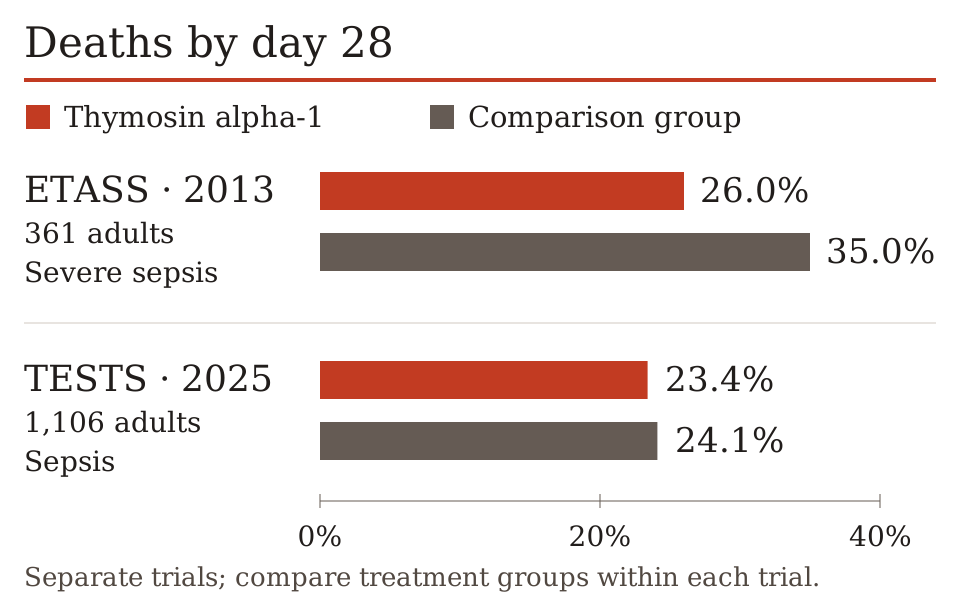
The ETASS trial enrolled 361 adults with severe sepsis, the dangerous condition in which the response to infection damages organs. By day 28, mortality was 26.0% with thymosin alpha-1 and 35.0% in the comparison group. The apparent advantage encouraged hope, although the statistical evidence was marginal and chance could not confidently be excluded.
Those 28-day mortality percentages tempted me, too. The outcome is survival, and the patients are gravely ill. But a later experiment had to answer whether the apparent advantage would hold up under a larger, more rigorous test. I’d have wanted that answer even if every proposed mechanism looked persuasive.
TESTS, 2025
The phase 3 TESTS trial enrolled 1,106 adults with sepsis across 22 centers. It was randomized, double blinded and placebo controlled: assignment was by chance, and both participants and investigators were unaware of treatment allocation. At day 28, mortality was 23.4% with thymosin alpha-1 and 24.1% with placebo. The trial found no statistically significant survival benefit.
The later result lowers my expectations for this use. It does not settle every possible application of thymalfasin, the synthetic form of thymosin alpha-1, but it directly tests the sepsis hope that earlier work had raised. I’d rather absorb that disappointment than leave the earlier figures hanging in the present tense.
The trials had separate populations and designs. Their mortality percentages can be read within each study; a change in the comparison-group rate across years cannot be credited to the peptide.
Thymosin, thymalfasin and the thymus
Thymosin alpha-1 is a 28-amino-acid peptide formed from a 113-amino-acid precursor. Its origins lie in the thymus, the upper-chest gland where some immune cells mature. The synthetic medicine thymalfasin matches the natural peptide. The comprehensive literature review describes its biology and years of clinical use.
The aging connection is easy to see: the thymus supplies fewer newly prepared immune cells with age. The proposed actions are more involved than simply turning immunity up. Thymosin alpha-1 can promote immune-cell maturation and signaling while also engaging processes that restrain excessive inflammation. In sepsis, both an inadequate defense and a harmful response matter.
The phrase “immune support” seems painfully small beside that balancing act. It also explains why I put the survival trial ahead of an appealing story about immune cells. The patient outcome is what the proposed balancing act had to deliver.

COVID-19 and cancer research
A retrospective review of 76 patients with severe COVID-19 reported mortality of 11.11% with thymosin alpha-1 and 30.00% without it, together with changes in T-cell counts and markers of exhaustion. Retrospective means the investigators looked back at care already given. Treatment assignment was not randomized, so other differences between patients could explain some or all of the association.
The cancer-therapy reappraisal considers thymosin alpha-1 alongside chemotherapy and immunotherapy, including ways its immune effects might help treatment or mitigate immune-related harm. That is an adjunctive research question, with its own diseases and treatment combinations. It cannot establish a general anti-aging benefit.
That collapse of contexts into a single assertion of stronger immunity exhausts my patience. Infection, cancer treatment and normal aging pose different problems. The interesting work is in the particulars.
Everyday reports and safety
People describe fewer colds, faster recovery, steadier energy or no noticeable change. Other accounts mention local itching, redness or stinging, short-lived aches, headache or fatigue. These are anecdotal accounts, not clinical evidence; none can establish that immunity improved or explain what caused a change.
The clinical review describes generally good tolerability, with local injection-site irritation the commonest adverse effect. That record is useful, though pregnancy and breastfeeding lack dedicated safety findings. Potential interference with deliberate immune suppression after a transplant, or with autoimmune disease, remains a mechanistic concern rather than an established harm in the trials discussed here.
Thymalfasin has approval in more than 35 countries and lacks FDA approval in the United States. The comparison gives the compounding-list snapshot. A “thymosin injection” search therefore needs its country, proposed use and particular substance attached. Thymosin alpha, thymosin alpha 1 and alpha 1 thymosin commonly lead to this peptide; the broad word thymosin also needs that specificity.